

Cool the rack, not the room: how we built T-RACKS
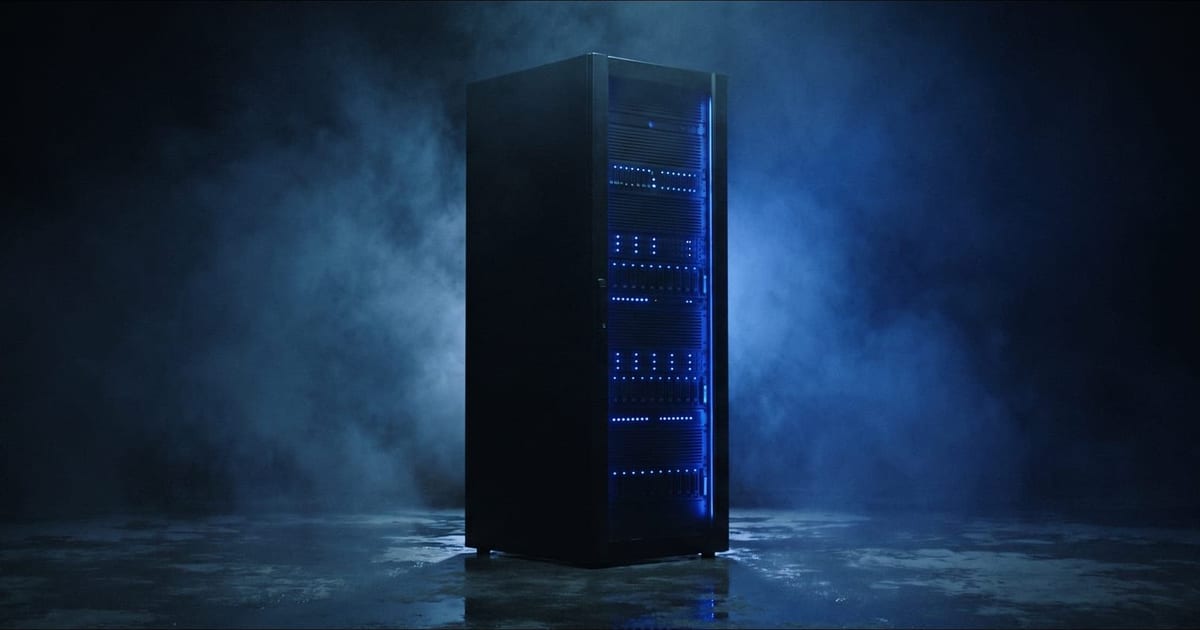
T-RACKS is an insulated rack cabinet that refrigerates its own internal volume instead of the room around it. The principle is the whole idea: the heat is generated inside the rack, so the cooling belongs inside the rack. Getting there took eight years, several prototypes and a lot of measurement.
Back in 2018 we kept running into the same scene: an air conditioning system sized for an entire room, running all day, when the heat that actually needed removing came from one or two racks in a corner. Far more air, and far more space, was being cooled than the job required.
The question we turned around
T-RACKS was born between two of our divisions that normally work on problems which never meet: IT services and refrigeration. It started the moment we stopped asking how powerful the room's air conditioner needed to be, and started asking something else.
Why cool the whole room, if the heat is generated inside the rack?
Changing the question changed the object. We were no longer designing a rack cabinet to sit inside an air-conditioned room, but a self-contained, controlled micro-environment, with cooling delivered straight to where the heat is produced.
We were asked more than once why we didn't just do what everyone else does. The answer is that "what everyone else does" was precisely the problem we had set out from.
The first prototype: a salvaged 160 cm cabinet
In May 2018 we put together the first working system: rack cabinet, refrigeration circuit, ventilation and temperature control in a single object. By June we had salvaged an old 160 cm cabinet and built the first cooling unit out of individual components already sitting in the workshop.
The first challenges were about placement long before they were about theory. Where to sit the cooling unit. Where the evaporator goes. And above all how to cool a sealed volume without condensation forming inches from the electronics. Those three questions still govern the design today: condensation is why the T-RACKS control continuously calculates the dew point.

Then came the long part: test after test. Measuring thermal behaviour takes heat, and heat takes a load. The first runs, between August 2018 and November 2019, ran on ten incandescent bulbs inside the cabinet. We swapped them for desktop computers, a more realistic load: they didn't produce enough heat. A real IT load, sealed inside an insulated volume, generates more than a couple of desktop machines can simulate.
Test rig back to the drawing board. At that stage of the project that was routine: measure, come up short, start again.
Insulation: from cabinet to refrigerator
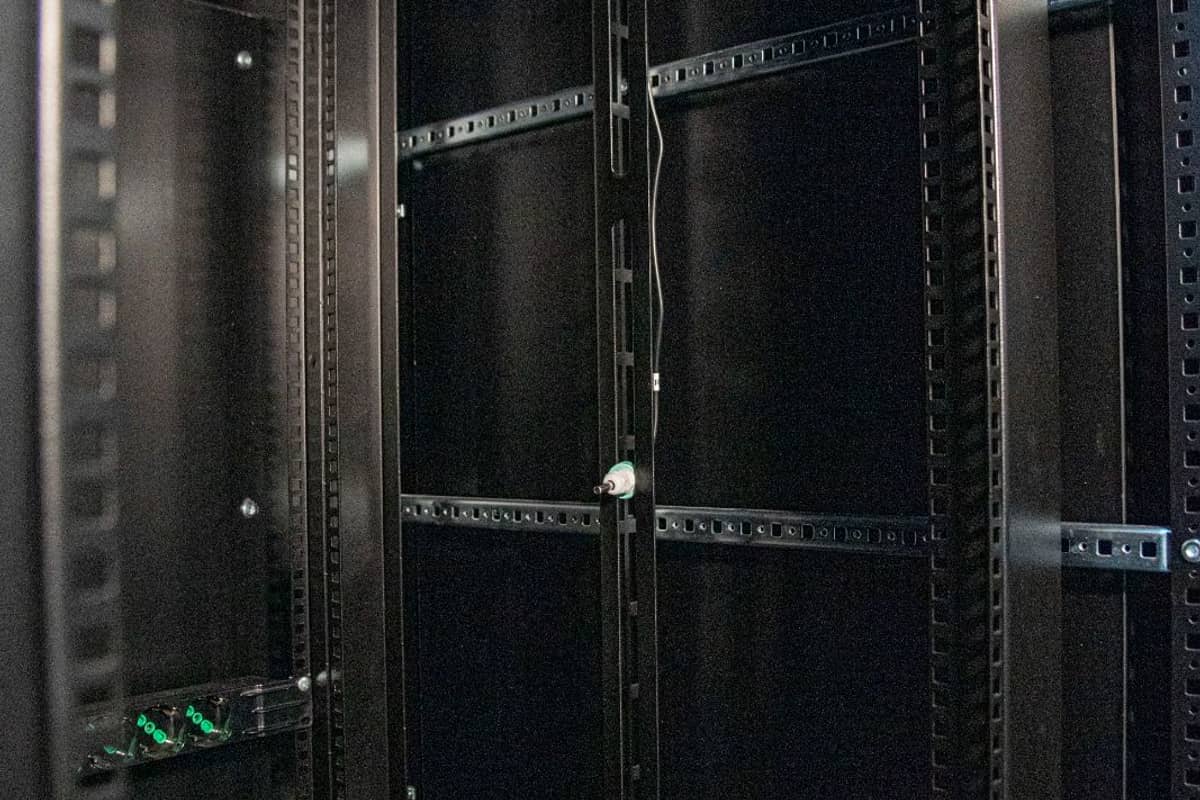
Between 2021 and 2024 the project changed gear. We insulated the inside of the cabinet, and at that point we were no longer cooling a rack: we were effectively running a refrigerator with electronics in it. We also stopped improvising the heat source — instead of light bulbs, a heater of roughly 2,000 watts.
With that rig we started comparing configurations on the numbers. These are the values measured on the insulated T-RACKS, with the 2,000 W heater as the thermal load:
- Cooling unit cycles — from around 8 per hour in the early runs to around 6 per hour after optimisation
- Set point — between 24 and 26 °C
- Cooling phase — in the region of 5 minutes
- Off period — often longer than 6 minutes
Fewer cycles, at the same maintained temperature, mean fewer compressor starts: less energy drawn and less wear. That is where T-RACKS stopped being a successful assembly and became a system whose response we know.
The people behind the project
A product born between two divisions needs people who speak both languages.
- Marcello Cozzolino, technical and refrigeration lead: the cooling circuit and the thermal behaviour of the system.
- Giulio Avella, CTO, responsible for the electronics and supervising the software.
- Antonio Di Marzo and Emanuele Di Costanzo, thermostat software development.
- Andrea Iaquinto, CEO, project supervision and the commercial side — and, by his own admission, the hardest tester to satisfy.

From cooling to control: SIMO
From 2025 cooling stopped being the only part of the story.
SIMO (Smart Indoor Management & Optimization) is the software that reads the cabinet's thermal state and collects its temperatures: it is the foundation for monitoring, control logic and alerting.
This is not about adding a dashboard. Without supervision, a cooling system tells you very little about itself: you know it's on, you don't know how it's working or why. SIMO makes what happens inside the rack visible. From there, the micro-climate can be governed.
SIMO has a path of its own. T-RACKS is where it finds its first application, and it is built as a product in its own right, with an independent commercial route.

Then came CAMI
CAMI was not in the original design. It came later, as a consequence: once SIMO could read the micro-climate and decide, something had to carry the decision out.
CAMI (Control And Monitoring Interface) is the board that turns SIMO's logical decisions into physical actions, keeping sensors and devices under continuous control. It arrived later in the order of reasoning; in the finished system the two carry equal weight.
Together, SIMO and CAMI automate functions that stay separate in a conventional installation — the cooling unit on one side, supervision on the other, often from different suppliers.
Both are in development, with integration planned across 2026 and 2027. No spoilers on the rest: we'll talk about the features once they are settled.
Where T-RACKS is today
T-RACKS exists, it is CE marked, and every unit so far has been designed, built and installed by us. It is now leaving the workshop.
This is the step that separates a product made to order from a product made in series: same machine, completely different process. In the first half of 2026 we fixed the three dimensional configurations — 80 × 80 × 100, 80 × 80 × 160 and 80 × 100 × 200 cm. Three sizes because both the volume to control and the heat to remove change between a small enclosure and a fully populated rack, and a single format would force half of all installations to cool empty space. The first CAMI board went in over the same period.

Validation testing runs in parallel: different IT loads, different ambient conditions, temperature, energy use, refrigeration cycles, reliability, behaviour over long runs. Their job is to freeze the configuration that goes into production.
The operating principle is proven. What remains is closing out validation, the applicable regulatory obligations and certifications, and the first production run: suppliers, testing and technical documentation all need to be stable before launch, planned for the second quarter of 2027.
One thing we would do differently, and we say it because it matters: we would have started measuring systematically much earlier. Temperatures, cycle times, energy use, logged from day one. Every decision that genuinely moved the project forward came from experimental data, and in the early years we collected less of it than we could have. We paid for that in repeated tests.
Who needs T-RACKS
Anyone running one or more servers without a proper server room:
- an office or an administrative site
- a warehouse or an industrial plant
- a branch site of a larger organisation
Organisations currently keeping an air conditioner running across an entire room to protect the equipment in one corner of it, and paying for that mismatch every month.
T-RACKS concentrates thermal control where the heat originates, instead of chasing it around the room. Dimensions, measured data and the full technical specification are on the T-RACKS page; the development milestones, in order, are on the project timeline.