

Live event production in Italy: flypack or OB van?
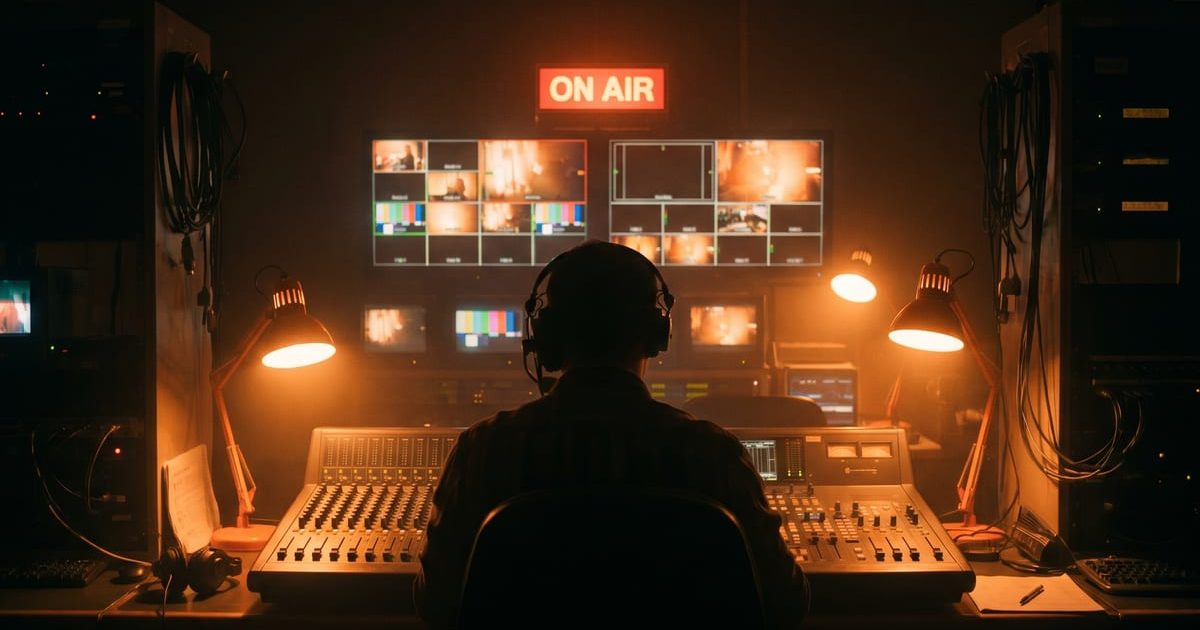
An OB van and a flypack control room do the same job: they mix the camera and microphone feeds and send them to air or to a stream. The difference is everything around the control room: parking, power, when the crew arrives, how many cameras it handles, what the extra day costs. Those line items decide the quote, and organisers usually discover them late.
This guide lines them up with public, mostly Italian figures, for anyone producing an event in Italy. We are a Naples crew running more than 50 live events a year with a flypack control room, and we know when it is not the right choice.
What an OB van is, and what a flypack is
An OB van (outside broadcast truck) is a vehicle fitted out as a control room, with vision mixer, audio, graphics, replay, intercom, air conditioning and often an on-board generator. The cameras connect to the truck.
A flypack is the same control room without the vehicle, in wheeled rack cases set up inside the venue. It is not a cut-down kit: Italy's public broadcaster RAI has used a fully flight-cased UHD control room since 2020 (SVG Europe), and in 2013 Sky Italia covered Formula 1 from a two-tonne flypack designed to be assembled in about three hours (SVG Europe).
Our flypack is a complete 4K control room: TriCaster 1 PRO with 4 M/E, Blackmagic router and Kiloview converters, up to 16 video sources at once, even across different networks, with built-in virtual set and character generator (TV Production).

Space and permits: parking, restricted zones, lifts
OB van. Even compact ones are trucks: one UK operator, for example, fits 8 cameras on a 3.5-tonne van and up to 10 on a 7-tonne vehicle (TVBEurope). It needs a parking spot close to the venue, and on public land that means a permit. In Bolzano, for example, the application goes in at least 30 days ahead, with the plates for the restricted traffic zone, and the council can charge for the bays (City of Bolzano / IDM). In an Italian historic centre, the permits can cost more than the hire.
Flypack. No permit to occupy public land: the van usually needs only access, which in a restricted zone still has to be authorised, and a bay to unload. It comes in through the door, takes the lift and is set up in a room, ideally away from the audience, because it has no air conditioning of its own and does not shut out noise.
Power: what to ask the venue
OB van. A truck-based control room needs a dedicated supply, from 32 A for small units up to 125 A for the largest. Get it in writing: it is often charged to the client, as in a public athletics quote (quote published by FIDAL). If the venue does not have one, you need a generator.
Flypack. It runs off the venue's sockets: a conference streaming crew, for example, asks for a 16 A socket near the control room (Streaming Aziendale). The weak point is continuity: a venue socket can lose power. So our control room travels with a 2 kVA UPS, and if the mains fail, the broadcast carries on.
Timing: the day before or the hours before
OB van. It often arrives the day before, and the FIDAL quote requires the venue from the previous day. That day is paid for: an extra setup day costs between 2,500 and 4,000 euros for the crew and between 1,500 and 3,500 euros for the venue (Event Pills).
Flypack. A pre-wired control room is not rebuilt for every event. It is positioned, connected and switched on within hours (Broadcast Management Group), and one industry estimate puts it at 2 to 3 hours against 6 to 8 for a traditional rig (Programming Insider). We go from arrival to on-air in 90 minutes, because router, mixer and encoders are already mounted and wired in the cases and each broadcast camera reaches the control room on a single fibre cable. So the organiser needs the room only from that morning.
Cameras: how many, and how far
How many. For a conference at least 2 to 3 cameras are recommended (Dacast). A concert or an amateur race uses 3 to 6. Serie A football produces to a 22-camera "Standard A" (Calcio e Finanza), and the 2025 Super Cup reached 36 (Corriere dello Sport).
How far. Here the cable matters, not the box. A coaxial SDI link covers about 100 metres in 3G, 80 in 6G and 50 in 12G, the format of 4K at 50/60p (Syntex, a Blackmagic reseller). Beyond that you need SMPTE hybrid fibre, the OB van standard: one cable carries video, programme return, intercom, tally and camera power over kilometres, and Blackmagic's converters are rated up to 2 km (Blackmagic Design).
We work with four cameras: three Blackmagic URSA Broadcast G2 on fibre up to 150 metres from the control room, with Fujinon 16x and 30x lenses, and a Canon CR-N500 PTZ operated remotely. When needed, one camera runs untethered on a wireless link.
In the control room: intercom, redundancy, graphics
A truck is a closed, quiet room; a flypack works where the venue allows. Three things close the gap:
- Always-on intercom (ours is Green-GO): director and operators on headsets, with tally on the cameras, so hall noise stays out.
- Redundancy: dual encoders, alternative signal paths, backup power (Broadcast Management Group).
- Graphics and virtual set built into the mixer, with no separate station.
Where the OB van stays ahead is multi-channel replay and super slow-motion for sport, with dedicated operators.
Live broadcast and streaming
For streaming, protocol and connection matter more than the hardware.
- RTMP or SRT. RTMP, the ingest protocol accepted by YouTube, Facebook and Twitch, has 2 to 5 seconds of latency and stalls on unstable networks. SRT, the professional standard, sits around one second and recovers lost packets (Wowza).
- Upload bandwidth. About twice the video bitrate: 8 to 12 Mbps for 1080p, 30 to 50 for 4K, preferably wired (Dacast). Without a wired line you need a multi-SIM mobile connection, which cost 700 euros in the FIDAL quote.
- The platform carries the audience: the control room only sends a handful of streams at a few megabits each.
We stream to TV, social media and websites at the same time. Our broadcasts have run on platforms handling up to 240,000 concurrent viewers, and the longest ran for 14 hours without a break.
What it costs
Italy has no public price lists for OB van hire, but there is at least one published quote, attached to a public tender: for a 4-hour athletics meeting in 2023, a 3-camera OB van with director and producer cost 6,500 euros, with 1,800 for two days of labour, 700 for 4G connectivity and 150 for drone permits on top, for a total of 9,150 euros plus VAT. The same supplier quoted a 3-camera web rig, mixed in software on a PC, at 5,950 euros (quote published by FIDAL). For conferences, a public price list runs from 500 euros with one camera to 3,000 with three (Streaming Aziendale).
Camera for camera, the control room itself costs about the same. The difference is the extras billed to the client when needed: power, generator, permits, venue from the day before, labour. Ask for them in writing.
When you still need an OB van
Even as a flypack crew, we would say you need one:
- when the broadcaster or rights holder requires it, with standards and camera counts a lightweight rig does not cover: Serie A's Standard A calls for 22 cameras (Calcio e Finanza);
- when you need several control rooms and parallel feeds, multi-channel replay, commentary booths or a satellite uplink;
- when the rig stays in place for days in a hostile environment: rain, heat, dust;
- when there is already an OB compound, as at a stadium or a racetrack.
For everything else, a flypack does the same job with simpler logistics.
Flypack and OB van side by side
| Item | Flypack | OB van |
|---|---|---|
| Space | A room inside the venue | Dedicated parking next to the venue |
| Permits | Usually just van transit and unloading | Public land and restricted-zone permits, sometimes 30+ days ahead |
| Power | Venue sockets, UPS recommended | Dedicated supply, from 32 A for small units up to 125 A, or a generator |
| Timing | Hours before (90 minutes for us) | The day before |
| Cameras | 2 to 16 sources | 3 to 30 |
| Camera distance | Depends on the cable: 50-100 m on SDI, kilometres on fibre | Same |
| Climate and noise | Down to the venue | On board |
| Replay and slow-motion | Limited | Multi-channel with dedicated operators |
| Streaming | Protocol and bandwidth matter | Same, plus on-board satellite |
| Cost | Similar control room, few extras | Similar control room, plus power, permits, venue and labour items |
Site survey checklist
- Where does the control room go, and from when is that space free?
- Is a public land or restricted-zone permit needed? Who applies?
- What power is needed, on which socket, and what happens if it fails?
- How many cameras, how far from the control room, on coaxial or fibre?
- How much upload bandwidth is there, and what is the backup?
- What remains the client's responsibility?
Frequently asked questions
What is the difference between an OB van and a mobile control room?
The terms are often used as synonyms, but "mobile control room" also covers the flypack. The OB van is specifically the fitted-out vehicle.
Can you broadcast live from a historic city centre in Italy?
With a flypack, yes: the control room goes inside the building and the van only needs transit. With an OB van you need a public land permit, applied for weeks ahead.
How much does a control room cost for an event?
There is no single price list: from a few hundred euros for one camera at a conference to several thousand for 3 to 4 cameras with streaming. Always ask which items are charged to you.
Producing an event in Italy? Send us the date, venue and format, and we will call you back with a quote that itemises every cost. Contact the TV Production division.